
A supercapacitor is an electrical energy storage system that charges very quickly and withstands an enormous number of cycles, but historically stored little energy for its weight. On a boat, this drawback made it unusable… until graphene-based technologies like Super Carbon, used by Yacht Power, which achieves approximately 160 Wh/kg. Here’s a simple explanation of how it works and what it changes onboard.
The essentials in 30 seconds
- A supercapacitor charges very quickly and withstands an enormous number of cycles.
- Its historical weakness: it stores little energy for its weight. Too little for a boat.
- Yacht Power uses graphene-based technology, Super Carbon, which achieves approximately 160 Wh/kg.
- Result: the speed and endurance of a supercapacitor, with enough energy for living onboard.
CONTENTS
What exactly is a supercapacitor?
Let’s start with the capacitor. All electronic devices contain them. They store electricity by accumulating charges on either side of an insulator, much like water held behind a dam. They charge and discharge instantly.
The supercapacitor takes this principle much further. Its electrodes, often made of carbon, offer an immense surface area at a microscopic scale: a single gram can represent the surface of a tennis court. Thus, it stores much more energy than an ordinary capacitor.
A battery, however, works differently. It stores energy within its materials, which takes longer to charge. Furthermore, each cycle wears it down slightly.
Its advantages: speed, endurance, stability
It is for these qualities that engineers have long been interested in them.
- It charges very quickly: no need to wait for hours.
- It withstands an enormous number of cycles, whereas a lithium battery manages a few thousand.
- It tolerates full discharges without damage.
- It operates within a wide temperature range.
Indeed, it is already found in electric buses, in the braking systems of some trams, and in wind turbines.
Its weakness: stored energy
However, the classic supercapacitor has a major flaw. It stores little energy for its weight: approximately 5 Wh/kg, according to a course from the Collège de France dedicated to supercapacitors. A lithium battery stores several tens of times more.
Concretely, to run air conditioning all night at anchor, you would need a mass of classic supercapacitors impossible to fit into a boat’s bilge. This is why they were not seen onboard.
Marine Supercapacitor: What Super Carbon technology changes
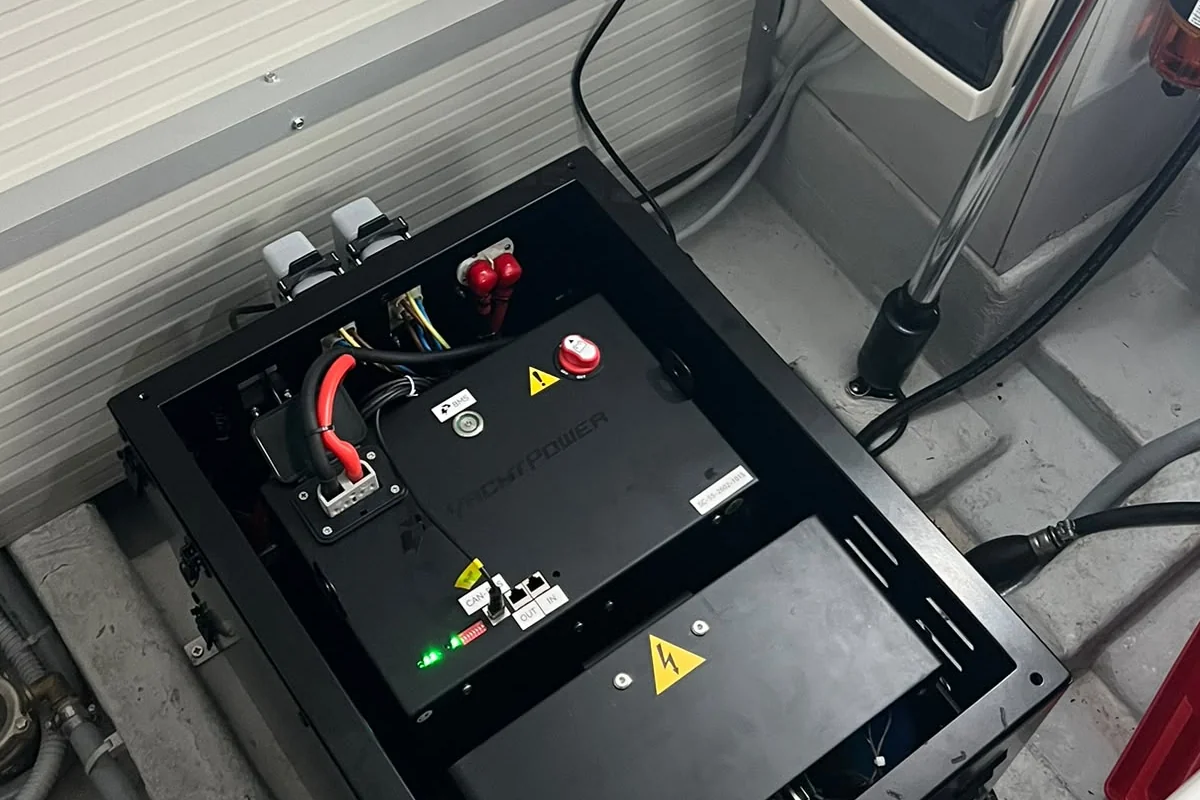
This is where Yacht Power stands out. Its modules are not based on classic supercapacitors, but on a proprietary graphene-based technology called Super Carbon.
Graphene is a form of carbon in a single-atom-thick layer. It is expensive and complex to produce, but its properties are exceptional for energy storage.
Result: approximately 160 Wh/kg at the complete module level. A 35 kg module stores 5.5 kWh of usable energy. In other words, an energy density comparable to that of a lithium battery, with the advantages of a supercapacitor:
- 20,000 guaranteed cycles, 100,000 nominal cycles;
- 100% usable capacity, without safety margin;
- 98% charge and discharge efficiency;
- no metallic lithium, no liquid electrolyte, no rare earths;
- operation from -20 °C to +60 °C.
To compare point by point with lithium, consult our comparison.
Concretely, what does a supercapacitor change onboard a boat?
For you, storage moves to the background. You no longer think about it.
- At anchor, 230 V is available silently, without a generator running. We explain this in our article on the onboard generator.
- In port, the storage recharges quickly and eases the load on the shore power connection.
- In winter, there’s almost nothing to do: a module loses less than 1% of its charge per month. Everything is detailed in our winterisation guide.
- Over time, the battery bank wears out much less quickly. Thus, the replacement anticipated with a lithium battery is significantly postponed.
Expert advice
When comparing storage systems, don’t just look at kWh. Also ask about the number of guaranteed cycles, the truly usable capacity, and the temperature range. That’s where the real differences lie.
Frequently asked questions
Can a supercapacitor really last a night at anchor?
A classic supercapacitor, no: it stores too little energy for its weight. Yacht Power modules with Super Carbon graphene technology, yes: each stores 5.5 kWh of usable energy, and as many as needed can be combined, up to 88 kWh per installation.
How long does it take to recharge a Yacht Power module?
A Yacht Power storage module accepts up to 5.5 kW for charging. It can therefore recharge in approximately one hour at full power, depending on the available source: shore power, generator, engines, or solar.
Is a supercapacitor system compatible with my boat?
Yacht Power connects to 230 V shore power, the onboard electrical panel, and the generator if there is one. The system is sized according to the boat's size and your usage: this is the purpose of the personalised study we offer.
In summary
The classic supercapacitor was fast and enduring, but too light on energy for a boat. With Super Carbon, Yacht Power retains its qualities and finally gives it the autonomy it lacked ⚡
Want to know what it would be like on your boat? Request our brochure, and we’ll take the time to explain.
Also read: Winterisation: How to preserve your boat’s batteries all winter
contact@yachtpower.fr · 06 15 78 06 77