On a boat, the generator has long been the only way to have 230 V at anchor. Air conditioning, ovens, water heaters: everything runs through it. But it comes at a price. Noise, smells, and maintenance. So, in 2026, is it still necessary to have one on board? Our answer is more nuanced than a simple yes or no.
The essentials in 30 seconds
- On a large yacht, the generator remains useful. However, it often runs for almost nothing.
- What wears it out the most is running for hours at low load during the night.
- On-board energy storage allows it to be switched off most of the time.
- On a 9–15 m boat without a generator, it is possible to have 230 V at anchor without installing one.
CONTENTS
Why the generator became standard on boats
The principle of a marine generator is simple: a diesel engine drives an alternator. Furthermore, it is robust, proven, and familiar to all mechanics.
In fact, for decades, there was no alternative. House batteries could not handle air conditioning or an oven. Away from the dock, the generator was the only serious source of 230 V.
This is no longer the case today. And that is where the question becomes interesting.
The true cost of a boat generator (not just in diesel)
Firstly, the noise and the smell. At anchor, the generator provides the background noise for the evening. For you, and for neighbouring boats. With exhaust fumes to boot, depending on the wind.
Secondly, the maintenance. Oil changes, filters, seawater pump impellers, anodes. On a boat, a generator is one more engine to look after. And one more seawater intake below the waterline.
Finally, wear and tear. This is the least understood point. A diesel engine does not like running at low load. Yet at night, at anchor, it often just powers the fridge, a few lights, and the air conditioning at idle. Consequently, it runs for hours for almost nothing. The result: carbon build-up, premature ageing, and accumulating engine hours.
We will detail the full cost of a generator over ten years in a future article.
Should you remove the generator from your boat? Our honest answer
In fact, it depends on your boat. And we prefer to tell you clearly.
| Your boat | Our advice | Why |
|---|---|---|
| Yacht over 15 m, with generator | Keep it, but run it much less | Your requirements are too high to do without it entirely |
| 9 to 15 m boat, without generator | Not necessarily a need to install one | Well-sized storage often covers usage at anchor |
The real issue is therefore not “generator or no generator”. It is: how many hours does it really need to run?
The principle: storing energy instead of producing it continuously
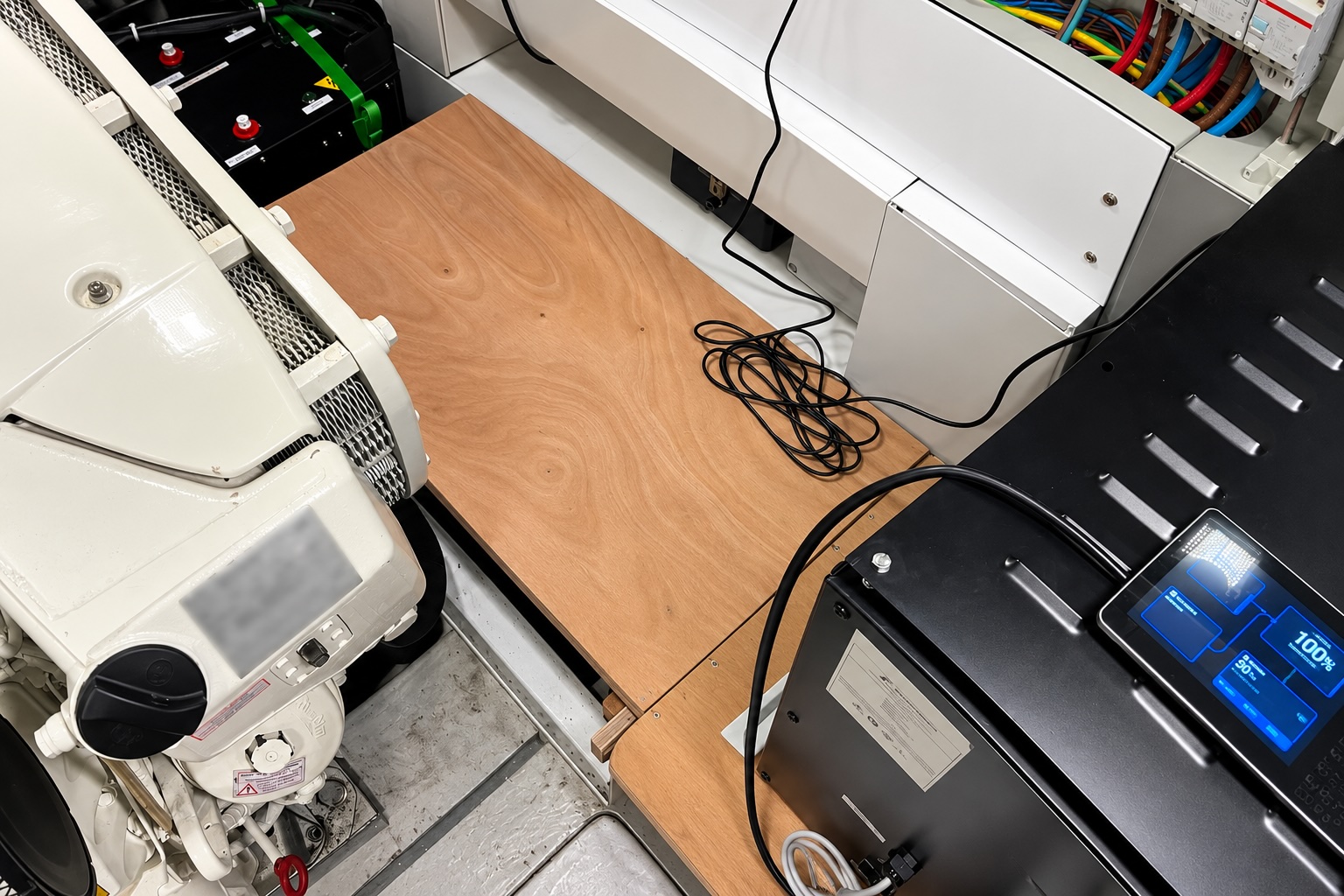
A supercapacitor storage system recharges at the dock, via the engines, through solar power, or via the generator. It then powers the boat with 230 V. In silence.
When the stored energy drops, the system starts the generator automatically. The generator recharges at a good load, then stops. Thus, it no longer runs just for a fridge. It runs to recharge at its ideal RPM.
On a Yacht Power system, the manufacturer claims up to 75% fewer generator hours and less fuel. Furthermore, the switch between sources takes less than 20 milliseconds: you won’t notice a thing.
How it changes daily life:
- No seawater intake, no oil changes. Maintenance is limited to a visual inspection each season.
- 20,000 cycles guaranteed and a 5-year manufacturer’s warranty.
- Everything is controlled from a 7-inch touchscreen, an app, or your navigation screen.
- In port, the system also assists the shore power pedestal. If the pedestal delivers 3 kW and the boat requires 4 kW, it provides the missing kilowatt. No more tripping the pontoon circuit breaker.
And on a 9 to 15 m boat without a generator?
Many owners give up on air conditioning or the oven at anchor. Others buy a portable generator. These are noisy, bulky, and not really in the spirit of cruising.
However, there is another way. A system sized for your boat, starting from a 5 kVA power unit and 5.5 kWh storage modules. The result: 230 V at anchor, without an engine running.
We will be honest, however: running air conditioning all night requires significant storage. That is why we size systems on a case-by-case basis, based on your actual needs.
FAQ: Frequently asked questions
Can I keep my current generator?
Yes. The system connects to and controls the existing generator. It does not replace it; it saves it.
What happens when the storage is empty?
With the auto-start option, the system launches the generator to recharge. Consequently, you have nothing to do.
Is it compatible with my boat?
The system is sized according to the boat’s size and requirements. This is precisely the purpose of the study we offer.
In summary
On board a boat, the generator has not had its final word. But it no longer needs to run all night 🌙
Want to know how this would work on your boat? Request our brochure or your personalised study. We will take the time to explain it to you.