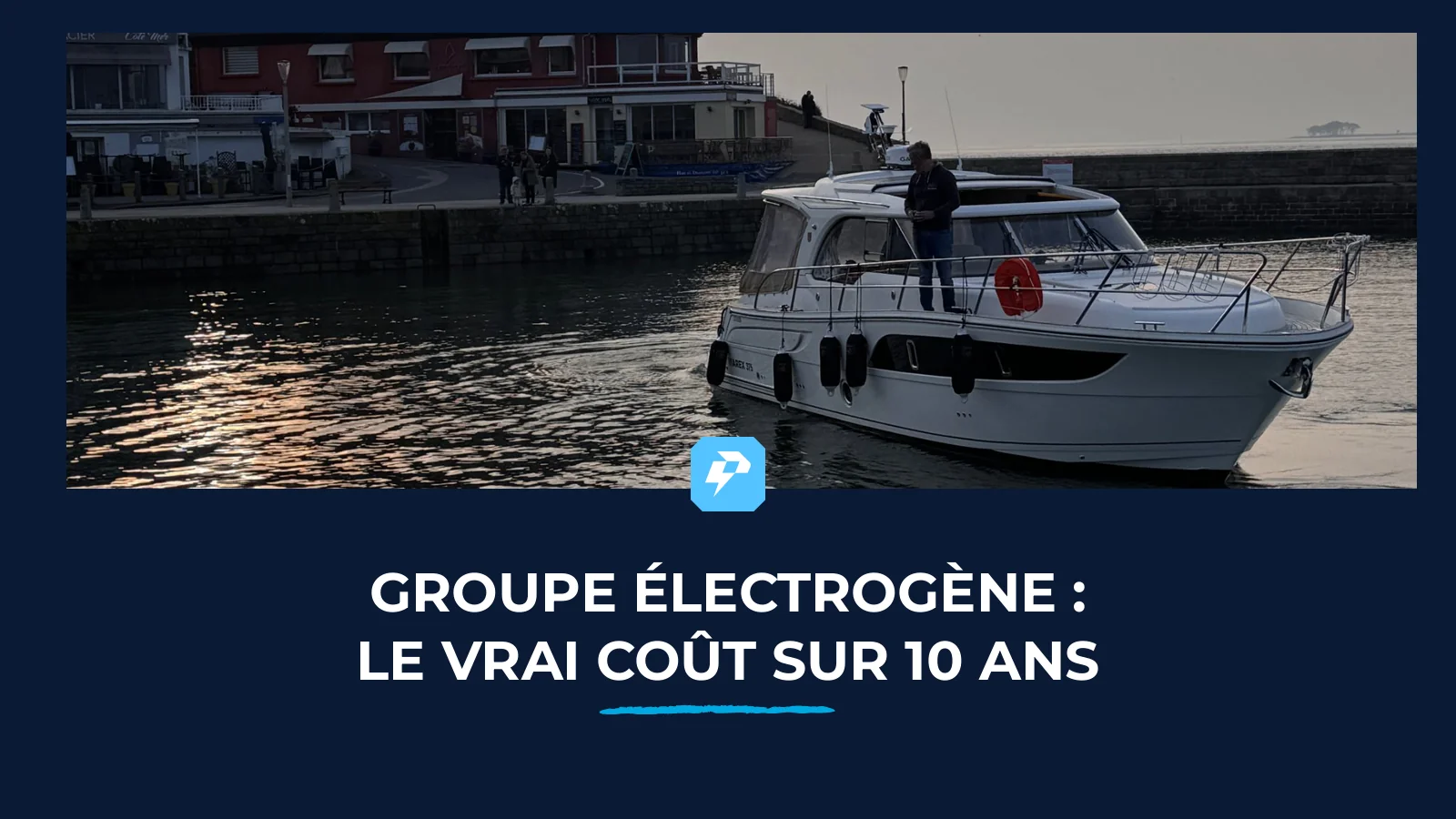
On a 15 to 18 m yacht, a generator running 300 hours per year costs approximately €2,600 per year in diesel and maintenance, or more than €26,000 over 10 years, excluding its purchase, major overhaul, or breakdowns. This cost depends primarily on one figure: the number of operating hours. Here is the breakdown, supported by assumptions, and how an energy storage system like Yacht Power changes things, reducing these hours by up to 75% according to the manufacturer.
The essentials in 30 seconds
- The primary cost is diesel: approximately 1,050 litres per year for 300 hours.
- Maintenance costs almost as much: oil changes, filters, impeller, anodes.
- Hidden costs come from wear at low load and accumulating engine hours.
- Fewer generator hours means less diesel, less maintenance, and a postponed overhaul.
Table of Contents
Boat generator cost: what truly counts
Attention is often focused on the purchase price. Yet over time, running costs represent the largest expense. These fall into three categories: fuel, routine maintenance, and long-term wear, which must eventually be paid for.
For this calculation, we consider a 15 to 18 m yacht whose generator runs for 300 hours per year. This is typical for an owner spending summer nights at anchor. You can, of course, recalculate using your own figures.
1. Diesel: the primary expense
The calculation is straightforward: operating hours × consumption × price per litre. At 3.5 litres per hour, 300 hours equates to 1,050 litres of diesel per year. At €1.40 per litre, that amounts to €1,470 annually, or €14,700 over 10 years at constant prices.
Furthermore, fuel prices are unlikely to decrease over a ten-year period.
2. Routine maintenance for a marine generator
A generator is an additional engine requiring upkeep: oil changes, oil, fuel and air filters, sea water pump impellers, sacrificial anodes, drive belts, and cooling system inspections. For a properly maintained unit, expect roughly €1,150 per year, including labour. In other words, €11,500 over 10 years.
Additionally, it introduces an extra through-hull sea water intake below the waterline, which requires regular monitoring.
3. Hidden costs: light loads and accumulated engine hours
This is the often-overlooked factor. Diesel engines deteriorate when run for extended periods under light loads. Yet at anchor at night, the generator frequently powers little more than a refrigerator and a few lights.
Consequently, it suffers from bore glazing and carbon build-up, ages prematurely, and accumulates engine hours. Major overhauls are required sooner, and resale value drops. These expenses do not appear on any single annual invoice, but they inevitably incur a cost.
10-Year Summary
| Item | Per Year | Over 10 Years |
|---|---|---|
| Diesel (1,050 L at €1.40) | €1,470 | €14,700 |
| Routine maintenance | €1,150 | €11,500 |
| Total excluding purchase | €2,620 | €26,200 |
| Major overhaul, breakdowns, light-load wear | unquantified | to be added |
Assumptions: 300 hours per year, 3.5 L/h, diesel at €1.40/L, and constant prices over 10 years.
How to reduce the cost of a boat generator
The real leverage does not lie in fuel prices, but in running hours. Every hour saved cuts fuel consumption, servicing costs, and mechanical wear simultaneously.
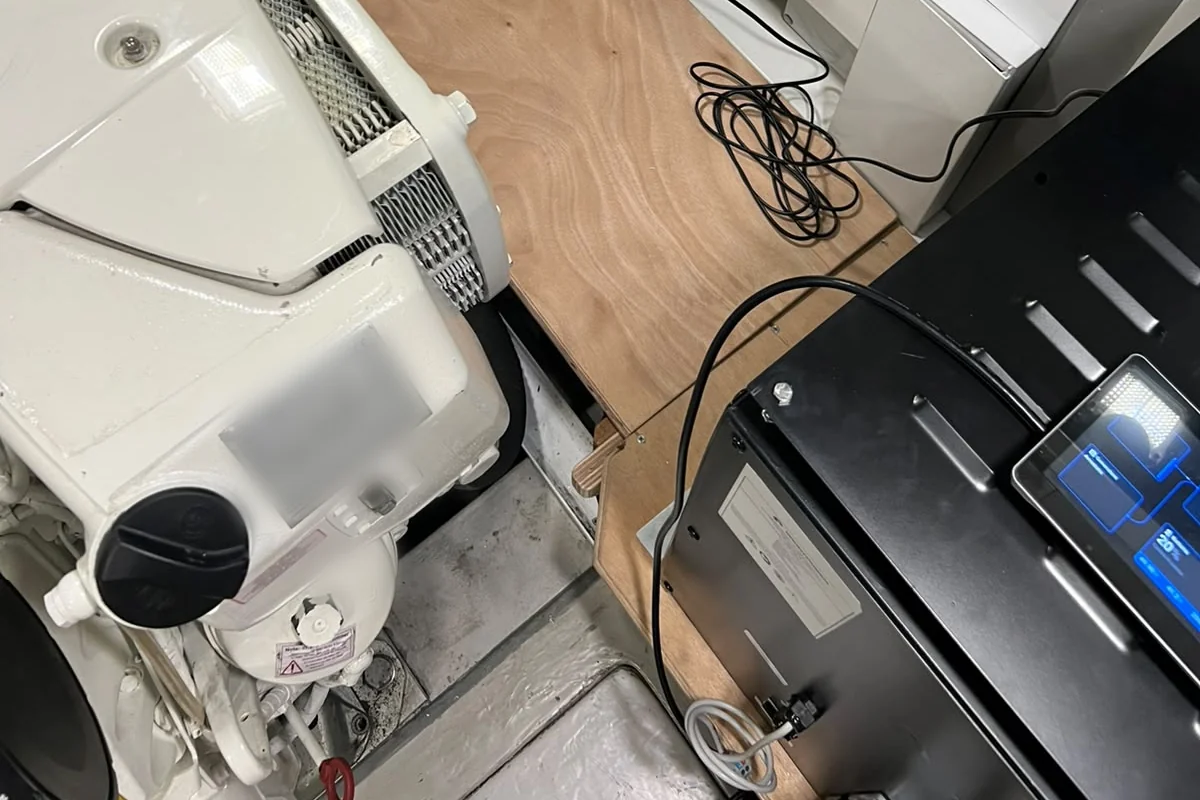
With Yacht Power, energy is stored onboard to supply 230 V power silently. The generator runs solely to recharge the storage bank at its optimal operating load, then shuts down. The manufacturer indicates up to a 75% reduction in generator run time and fuel consumption.
On a 15 to 18 m yacht, compared to an equivalent diesel generator and lithium battery bank:
- initial purchase costs are at parity;
- over 5 years, the total cost drops by approximately 30%, representing nearly €19,400 in savings;
- over 10 years, it decreases by approximately 53%, saving over €51,700, including replacement of the lithium battery bank in the seventh year.
The full breakdown is available on our Savings page. To learn how the generator is managed, read our article Marine Generators: Do You Still Need One Onboard?
Expert advice
Record your generator’s hour meter at the start and end of each season. This is the single most valuable metric for understanding its true operating cost and correctly sizing an energy storage system.
Frequently asked questions
How much fuel does a boat generator consume?
This depends on its power rating and electrical load. For a 15 to 18 m yacht, an average consumption of 3.5 litres of diesel per hour is typical, equating to approximately 1,050 litres for 300 hours of operation per year.
How much does annual marine generator maintenance cost?
Expect around €1,150 per year for a well-maintained unit: oil changes, filters, sea water pump impeller, anodes, and cooling circuit checks. This figure increases with higher operating hours.
Can you retain your existing generator with Yacht Power?
Yes. Yacht Power manages the existing generator: it starts it purely to recharge the energy storage system at its optimal load, then turns it off. The manufacturer reports up to a 75% reduction in generator hours and fuel consumption.
In Summary
Over 10 years, a generator costs considerably more than its initial purchase price: upwards of €26,000 in diesel and maintenance in our example, before accounting for wear. The key lever is running hours. And that is precisely what Yacht Power reduces ⚡
Would you like a customised calculation for your vessel? Request your personalised assessment, and we will model it using your figures.
Further reading: Supercapacitors vs Lithium Batteries: An Objective Comparison
contact@yachtpower.fr · 06 15 78 06 77