Supercapacitors or lithium batteries: on board, both store energy, but not in the same way. The LiFePO4 lithium battery is a proven technology, with a lower entry cost for a small bank. Yacht Power’s Super Carbon graphene technology supercapacitors offer more cycles, 100% usable capacity, charging from -20°C to +60°C and no thermal runaway to fear according to the manufacturer. Here is the criterion-by-criterion comparison, without bias, to help you choose according to your boat and your sailing programme.
The essentials in 30 seconds – On safety, cycles, cold and usable capacity, the advantage goes to Super Carbon supercapacitors. – On the entry cost of a small bank and ease of replacement in 12V, lithium retains the advantage. – Over the long term, replacing the lithium bank often changes the calculation. – The right choice depends on your consumption, your programme and the space on board.
Table of Contents
Supercapacitor or lithium battery: two ways to store energy
A LiFePO4 lithium battery stores energy at the heart of its materials. It is dense and efficient, but each cycle wears it out a little, and it needs a BMS to stay within its voltage and temperature limits.
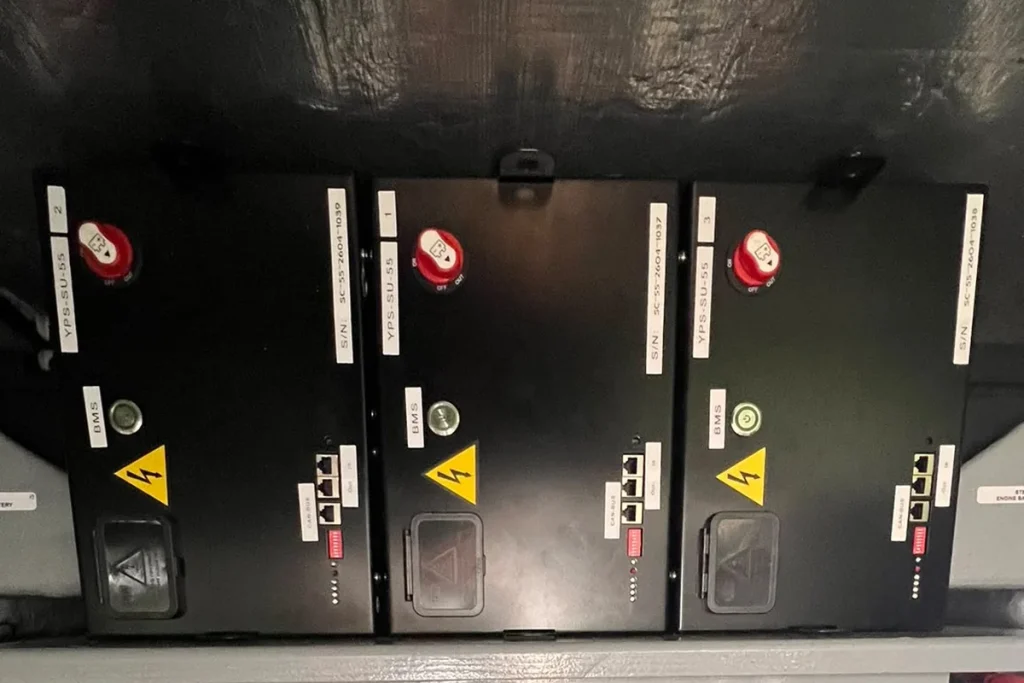
Yacht Power supercapacitors rely on a proprietary graphene-based technology, Super Carbon. They reach approximately 160 Wh/kg at the module level, while retaining the qualities of supercapacitors: speed, endurance and stability. To understand the difference with a classic supercapacitor, read our article Supercapacitor: what is it?
The 8 criteria for comparison
1. Safety and thermal stability
LiFePO4 is the most stable lithium battery. However, overcharging, impact or charging in cold weather can cause thermal runaway. Yacht Power modules have neither metallic lithium nor liquid electrolyte: according to the manufacturer, there is no thermal runaway to fear. We detail these risks in our article on the real risks of lithium batteries on board.
2. Lifespan and number of cycles
A quality LiFePO4 battery lasts a few thousand cycles. A Yacht Power module guarantees 20,000, for 100,000 nominal cycles. In other words, for equal use, the storage wears out much more slowly.
3. Actually usable capacity
With lithium, the vast majority of the capacity is used, but the BMS keeps a margin to protect the cells. With Yacht Power, 100% of the capacity is usable, without the risk of damaging the storage by emptying it completely.
4. Cold and heat
This is a key point in Brittany as in the Mediterranean. A lithium battery does not recharge below 0°C without a heating system, and the heat of a bilge in summer accelerates its ageing. Yacht Power modules operate, and recharge, from -20°C to +60°C.
5. Charging speed and power
The charging power of a lithium battery depends on its BMS and the manufacturer. A 5.5 kWh Yacht Power module accepts up to 5.5 kW in charging: it can be recharged in about an hour at full power. The 10.2 kWh module accepts 6 kW in charging and delivers up to 7.5 kW.
6. Weight and dimensions
On this point, the two technologies are of the same order. A Yacht Power module weighs 35 kg for 5.5 kWh usable, or 75 kg for 10.2 kWh. On the other hand, the system also requires a power unit for 230V, starting from 50 kg for 5 kVA, which replaces your inverter.
7. Maintenance and supervision
Lithium requires little maintenance, but monitoring of the BMS and temperatures. Yacht Power is limited to a visual inspection per season. The system is controlled from a touchscreen, an app or your navigation screen via NMEA 2000.
8. Cost over time
For a small 12V service bank, lithium costs less to buy. Compared to a generator and lithium bank set, Yacht Power is at the same level from the point of purchase. Then, the gap widens: a lithium bank is often replaced around the seventh year, whereas with 20,000 guaranteed cycles, this replacement disappears from the calculations. Good to know: the 10.2 kWh module offers almost twice as much capacity as the 5.5 kWh, for an almost identical price.
Supercapacitor or lithium battery: summary table
| Criterion | LiFePO4 Lithium | Yacht Power Super Carbon |
|---|---|---|
| Safety | stable, but thermal runaway possible | no thermal runaway to fear, according to the manufacturer |
| Cycles | a few thousand | 20,000 guaranteed, 100,000 nominal |
| Usable capacity | the vast majority | 100% |
| Cold weather charging | not below 0°C | from -20°C to +60°C |
| Charging power | depending on BMS and manufacturer | up to 5.5 kW (5.5 kWh module) or 6 kW (10.2 kWh module) |
| Weight | similar order | 35 kg (5.5 kWh) or 75 kg (10.2 kWh) |
| Maintenance | BMS monitoring | visual inspection per season |
| Cost | cheaper to buy for a small bank, replacement often around the seventh year | at the same level as a generator and lithium set at purchase, no bank replacement to plan for |
What lithium does better
An honest comparison must say it: lithium retains real advantages.
- It directly replaces a 12V or 24V lead-acid bank, without changing the on-board architecture.
- For a small bank, its entry cost is lower.
- The choice of brands and the network of installers are very wide.
- It benefits from several years of experience in yachting.
Le Figaro Nautisme has also published a complete dossier on what you need to know before installing LiFePO4 batteries on board.
What Yacht Power changes on board
Yacht Power does not just replace a battery bank. It is a complete system: storage, 230V conversion, shore power and generator management.
- At anchor, 230V is available in silence, and the generator only starts to recharge.
- In port, the system relieves the shore power pedestal when the boat demands more than it delivers.
- In winter, it remains on standby, without cutting anything off.
- Your traditional 12V or 24V batteries remain as a buffer for starting, the windlass and the thruster.
For a complete refit, follow our six-step method in the article Energy refit: where to start? And discover the whole range.
Expert advice Never compare two storage systems on the price per kWh alone. Ask for the actually usable capacity, the number of guaranteed cycles and the probable date of the first replacement. That is where the real difference is made.
Supercapacitor or lithium battery: your questions
Does a supercapacitor completely replace a lithium battery on a boat?
For the service bank, yes: Yacht Power's Super Carbon graphene technology supercapacitors replace the lithium or lead-acid batteries that power the boat. Small traditional 12V or 24V batteries remain as a buffer for engine starting and high-current demand equipment.
Which is safer on board, the supercapacitor or the lithium battery?
LiFePO4 is the most stable lithium battery, but thermal runaway remains possible in the event of overcharging, impact or non-compliant installation. Yacht Power modules have neither metallic lithium nor liquid electrolyte: according to the manufacturer, there is no thermal runaway to fear.
Which costs less, the supercapacitor or the lithium battery?
At purchase, a small 12V lithium bank costs less. Compared to a generator and lithium bank set, Yacht Power is at the same level from the point of purchase, then the gap widens with the replacement of the lithium bank, often around the seventh year.
In summary
Lithium remains a good solution for a small 12V bank. But if you are looking for safety, endurance and a silent boat without lithium batteries, Yacht Power’s Super Carbon supercapacitors are a game changer ⚡
Hesitating between the two? Request our brochure, we’ll take the time to explain it to you.
Also read: Energy refit: where to start when modernising your boat?
contact@yachtpower.fr · 06 15 78 06 77