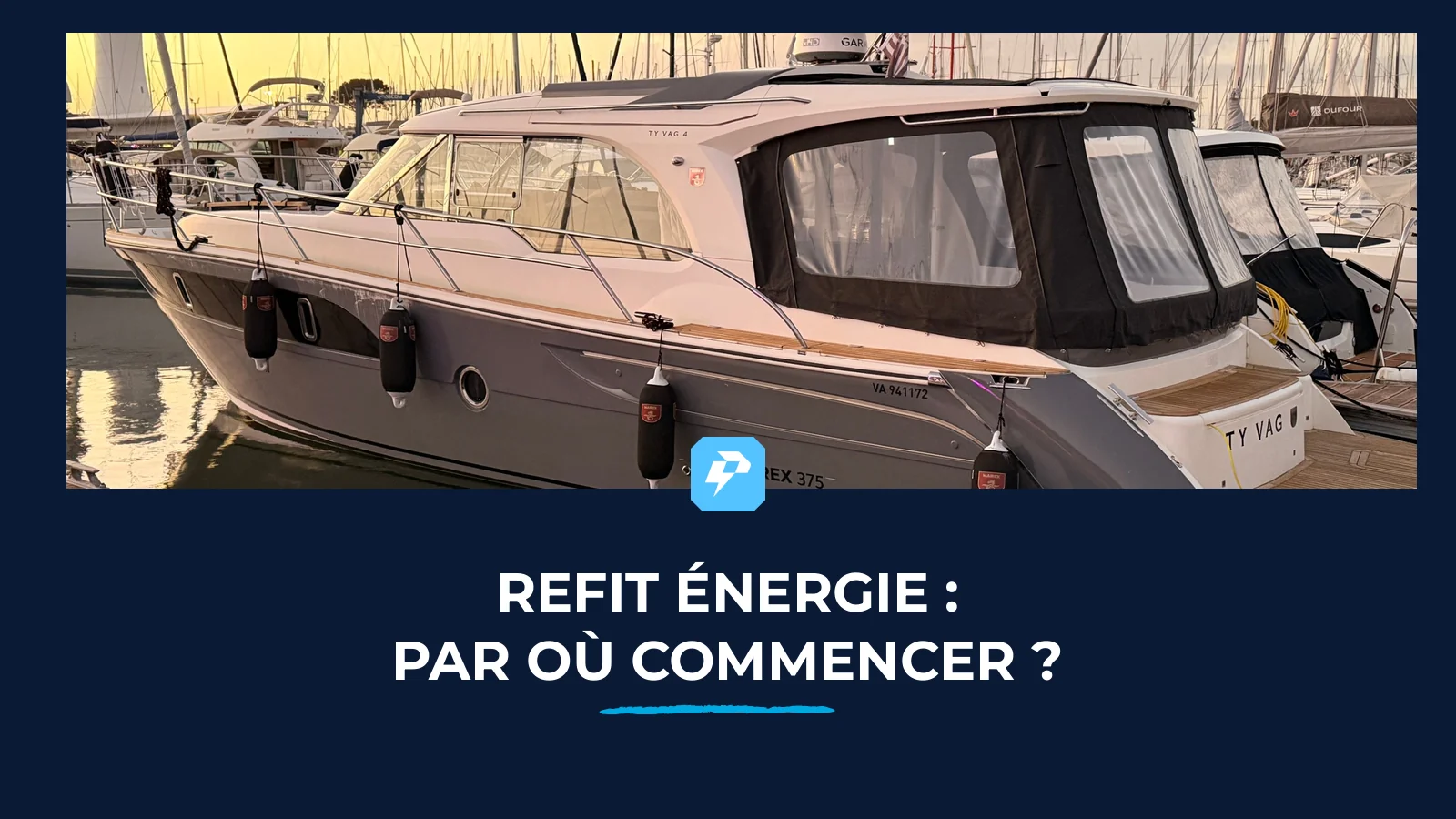
A successful boat electrical refit begins with an energy audit, not with buying batteries: you must first know what is being consumed on board, where and when. Then comes the assessment of the installation, the choice of storage (lead-acid, lithium or supercapacitors), charging sources, 230 V management and supervision. Here are the six steps in order, and the mistakes to avoid, whether you keep your current installation or switch to Yacht Power.
The essentials in 30 seconds
- Do not choose storage before measuring your actual needs.
- Winter is the best time: the boat is available and so are the installers.
- The choice of storage determines everything else: charging, wiring, maintenance and budget over ten years.
- A good refit is well documented: up-to-date diagrams, compliance, and insurer notified.
Table of Contents
Boat electrical refit: why winter is the right time
During the season, we sail. You don’t dismantle a battery bank in July.
In winter, however, the boat is at the quay or on the hard, and boatyards have more availability than in the spring. Furthermore, you have time to compare solutions without being rushed by the next departure. A refit launched in November is often finished well before relaunching.
The 6 steps of a successful energy refit
1. Carry out an onboard energy audit
This is the step that is skipped all too often. Yet, everything depends on it. List every piece of equipment, its power rating and its duration of use per day: fridge, lighting, electronics, pump, air con, oven, water heater. This gives you your daily consumption in kWh, at anchor as well as in port.
2. Assess the current installation
Age and condition of batteries, cable cross-sections, electrical panel, shore power, charger, alternator: everything is reviewed. A marine electrician also checks compliance with the ISO 13297 standard, which governs electrical installations for small pleasure craft. This is the time to identify what can be kept.
3. Choose the storage technology
This is the heart of the refit. Three main families exist today:
| Criteria | Lead-acid or AGM | Lithium LiFePO4 | Yacht Power Super Carbon |
|---|---|---|---|
| Usable capacity | approx. half | the vast majority | 100% |
| Lifespan | a few hundred cycles | a few thousand cycles | 20,000 cycles guaranteed |
| Cold weather charging | possible, slower | not below 0°C | from -20°C to +60°C |
| Points of vigilance | weight, sulphation | BMS, installation, thermal runaway | sizing according to your needs |
| Replacement required | every few years | often around the seventh year | not expected within the warranty period |
To go further, read our article on the real risks of lithium batteries on board and the one on the supercapacitor.
4. Plan the charging sources
Storage is only as good as its charging. You must therefore plan how it is refilled: shore power, engine alternator, solar panels, generator. Each source requires the right equipment, for example a DC-DC charger for the alternator or an MPPT regulator for solar.
5. Consider 230 V and supervision
Do you want air con, the oven or the water heater at anchor? If so, you need sufficient 230 V conversion and an automatic switch between shore power, storage and the generator. Also think about supervision: an on-board screen, an app, or integration into your navigation screen.
6. Entrust the installation to a professional and document it
Finally, have the work carried out by a qualified installer. Demand an up-to-date electrical diagram and a certificate of conformity. And notify your insurer before the work begins, especially if you are changing battery technology.
Boat electrical refit with Yacht Power: how it integrates
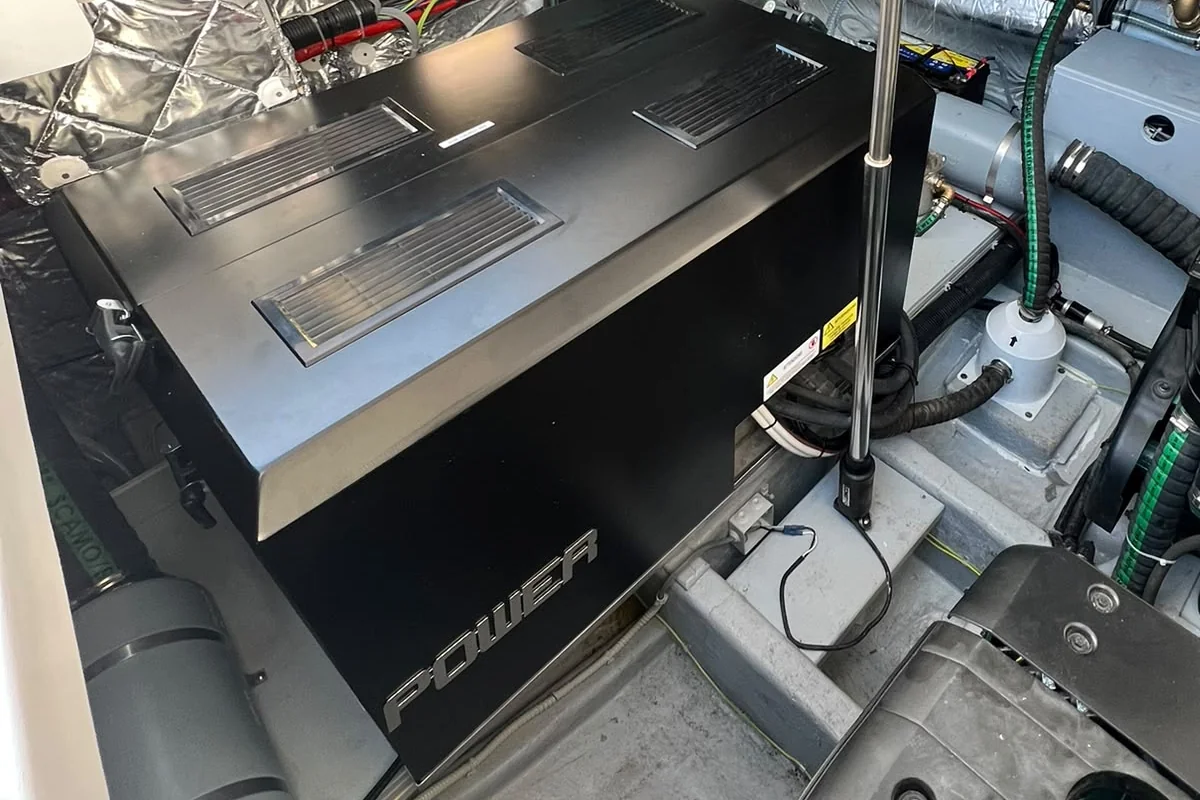
Yacht Power was designed to be installed on an existing boat, without redoing everything.
- The system connects to the 230 V shore power, the on-board electrical panel and the generator if there is one.
- It integrates into the NMEA 2000 network without programming, including on Garmin screens.
- Your traditional 12 V or 24 V batteries remain in place as a buffer for starting, the windlass and the thruster. Yacht Power storage keeps them charged via DC-DC converters.
- Charging is done via shore power, the alternator via a DC-DC converter, or solar via an MPPT regulator.
- Regarding footprint, allow for a 50 kg power unit for 5 kVA, and storage modules of 5.5 kWh (35 kg) or 10.2 kWh (75 kg).
Good to know: the 10.2 kWh module offers almost twice the capacity of the 5.5 kWh one, for a near-identical price. If it fits on board, it is often the best choice. Discover the full range.
Expert advice
Never buy your batteries before carrying out your energy audit. Under-sizing means running out of energy at anchor. Over-sizing means paying for and carrying unnecessary kilos.
Frequently asked questions about boat electrical refits
How long does an electrical refit take on a boat?
This depends on the scale of the work: from a few days for a battery bank replacement to a few weeks for a complete installation. The key is to plan it out of season, in winter.
Can I keep my current batteries with Yacht Power?
Yes, in part. Traditional 12 V or 24 V batteries remain on board as a buffer for starting and high-current equipment, if they are in good condition. Yacht Power replaces the service battery bank.
Do I need to change the electrical panel to install Yacht Power?
Not necessarily. Yacht Power connects to the existing electrical panel. The assessment of the installation will determine if it needs modernising.
In summary
A successful energy refit follows a method: measure, check, choose, recharge, control, document. And if you want a silent boat without lithium batteries, Yacht Power integrates into your existing installation ⚡
Are you preparing a refit this winter? Request your personalised study, we will take the time to explain it to you.
Also read: Lithium batteries on board: the real risks and how to master them
contact@yachtpower.fr · 06 15 78 06 77