
To successfully winterise a boat battery, three steps are enough: charge it, switch off consumers and check the voltage once a month. A lead-acid battery left discharged all winter can lose part of its capacity irreversibly. Lithium follows different rules: it is stored at an intermediate charge and should not be recharged below 0°C. Here is our complete guide: lead-acid, AGM, lithium and Yacht Power.
The essentials in 30 seconds
- A lead-acid battery discharged all winter will be damaged, sometimes irreversibly.
- Lithium is not winterised like lead-acid: avoid storing it full, and do not charge it below 0°C.
- Whether in the marina or on land, switch off consumers and check the charge once a month.
- Energy storage that discharges very little makes winter much simpler.
Contents
Why winterising boat batteries matters so much
In winter, the boat does not sail. However, its batteries continue to live.
Firstly, they discharge by themselves, slowly. This is self-discharge. Secondly, some equipment consumes power quietly: alarms, bilge pumps, electronic standby modes. Finally, the cold slows everything down and makes recharging more difficult.
The result: a battery well charged in October can be flat by March. And a lead-acid battery that remains discharged for weeks will be damaged. Crystals form on the plates; this is sulphation. After a while, the lost capacity cannot be recovered.
There is also a lesser-known risk. A discharged lead-acid battery freezes much more easily than a full one. In extreme cold, the casing can crack.
Lead-acid and AGM batteries: the right winterising steps
This is the most common case on board. And it is also the simplest, provided you follow the correct order.
- Recharge to 100% before leaving the boat. A full 12V battery shows about 12.7V at rest.
- Turn everything off with the battery isolator switch, except for what must remain powered (e.g. automatic bilge pump).
- Clean the terminals and grease them lightly to prevent oxidation.
- On an open lead-acid battery, check the electrolyte level and top up with demineralised water if necessary.
- Check the voltage once a month. If it drops significantly, recharge.
In the marina, a charger with a maintenance (floating) mode connected to shore power does this job automatically. On land, without electricity, the battery isolator and monthly checks are sufficient.
Winterising a boat’s lithium battery: the rules change
Lithium winterises better than lead-acid: it discharges more slowly and does not sulphate. However, it has its own rules.
Firstly, avoid storing it full. Most manufacturers recommend an intermediate charge level for the winter, often around half. Next, switch off the BMS or consumers, according to the manual. Finally, do not recharge a lithium battery below 0°C, unless it is equipped with a heating system designed for that purpose.
The safest way is to follow your manufacturer’s instructions, as settings vary from one brand to another. Le Figaro Nautisme has also published a comprehensive report on what you need to know before installing LiFePO4 batteries on board.
In the marina or on land: what changes for your batteries
In the marina, you have shore power. This is a real convenience: a good charger maintains the charge all winter. However, check that your shore power cable is in good condition and that the marina regulations allow a permanent connection.
On land, in a boatyard, there is often no electricity. Everything therefore relies on a battery being well charged at the start and on the battery isolator switch. Also consider humidity: a boat closed up all winter will suffer from condensation, and electricity does not like that. Ventilation or a moisture absorber in the technical room costs almost nothing.
On a small boat, some owners take their lead-acid batteries home, to a dry and frost-free place. This is effective, but heavy. Keep this option for batteries that are easy to remove.
And with Yacht Power storage?
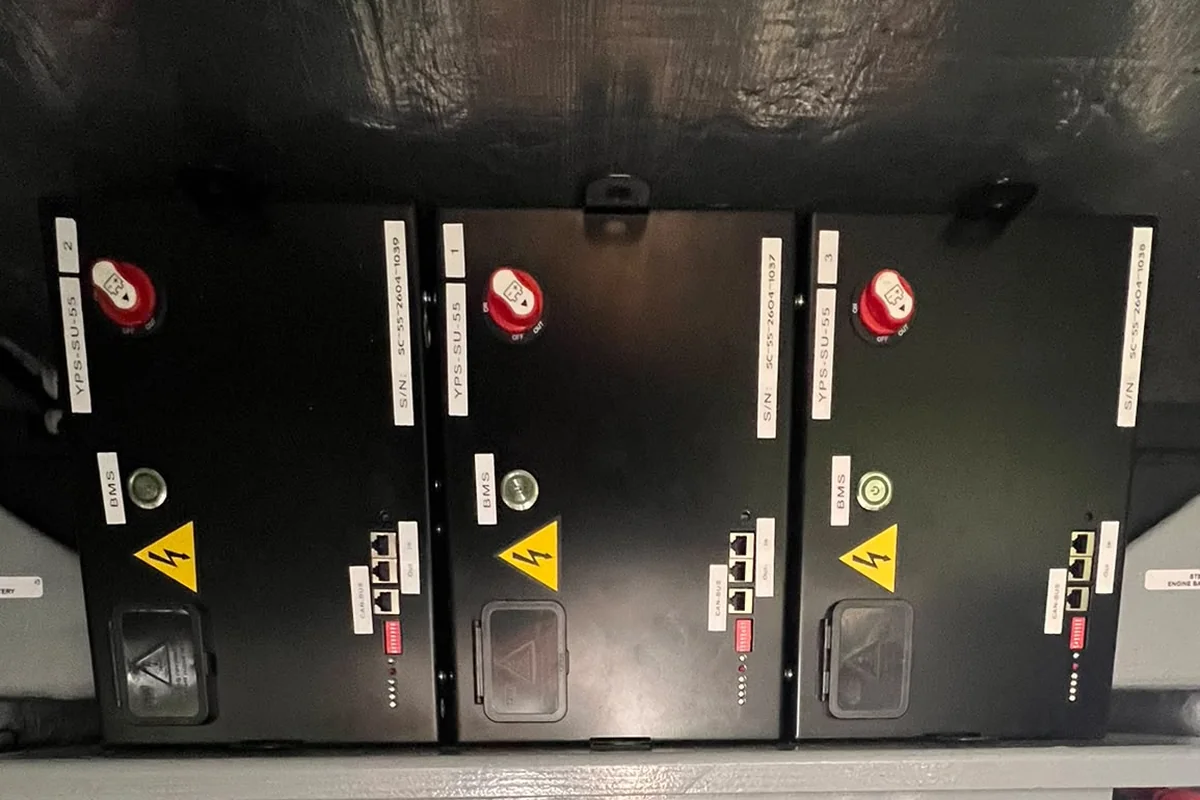
On a boat equipped with a Yacht Power system, winter is significantly simpler.
Firstly, there is almost nothing to do. The system remains on standby, and everything stays powered. The modules do have battery isolators, but there is no need to switch them off. In the marina, connected to shore power, it maintains itself. On land, without electricity, you can also leave it on standby. And if it were to eventually run flat, there is no damage: it supports full discharges without needing a safety margin.
Secondly, a storage module on its own discharges very little: less than 1% per month. The system on standby consumes a little to remain ready for operation. That is why, in winter, the simplest thing is to leave it connected to shore power. Furthermore, the modules operate from -20°C to +60°C. The cold of a bilge in January does not bother them.
Regarding safety, the modules are based on supercapacitors with Super Carbon graphene technology. No rare earths, no metallic lithium, no liquid electrolyte like in a lithium-ion battery. There is therefore no risk of thermal runaway, whether the bilge freezes in winter or heats up in summer.
Finally, the system can be monitored remotely. From the app, you can check the charge level without travelling to the marina. Winterising is also the right time for the only planned maintenance operation: one visual inspection per season.
Expert advice
Do your electrical winterising on the same day as the engine winterising. You won’t forget it, and you’ll leave with peace of mind.
Your boat battery winterising checklist
- Batteries recharged (lead-acid, AGM) or at the level recommended by the manufacturer (lithium).
- Battery isolator switch to “off”, except for essential circuits.
- Terminals clean and protected.
- Maintenance charger connected if you stay in the marina.
- Technical room ventilated or equipped with a moisture absorber.
- Reminder in your calendar: check the voltage once a month.
Frequently asked questions
Should I remove the batteries from the boat for the winter?
Not necessarily. A charged, disconnected and dry battery will spend the winter on board very well. Removing it is only useful if the boat remains on land without any checks for months.
Can I leave the charger plugged in all winter?
Yes, if it is a charger with maintenance mode and the marina allows it. Indeed, this mode delivers just enough to compensate for self-discharge.
Is a poorly winterised battery lost?
Not always. However, a lead-acid battery left discharged for a long time often loses part of its capacity for good. Have it tested before the season starts.
In summary
Winterising a boat battery comes down to three words: charge, cut, check. This way, you will find a boat ready to sail in the spring ⚓
And if you are already preparing for next season, perhaps it is time to rethink your on-board energy. Request our brochure; we will take the time to explain it to you.
Also read: Generators on a boat: do you still need one in 2026?
contact@yachtpower.fr · 06 15 78 06 77